
Spotting on walls, baseboards and ceilings after something got wet
Mold After Water Damage in Lithia Springs, GA
Dark spots after a leak call for a look at the size of the patch and where the water came from, since the EPA treats a patch under about 10 square feet differently from a larger one. Call (678) 940-9083 to ask whether a local contractor can take a look.
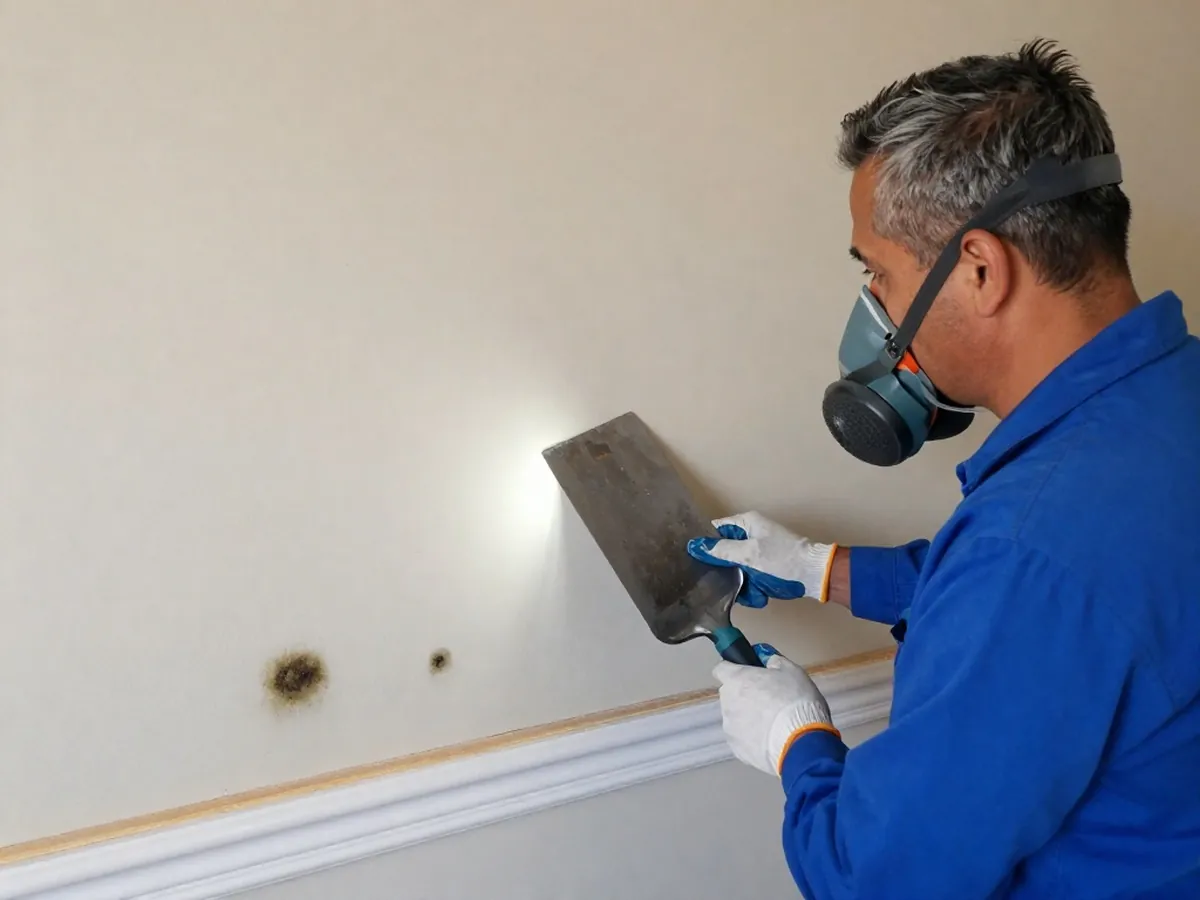
About this rendered scene
What the cut-away wall shows
The rendered scene shows a section of drywall and baseboard cut away from a bedroom wall. Dark spots show on the hidden face of the drywall and across a wood stud, which is the side of a wall nobody sees from the room. A technician in an N95 respirator and gloves holds a flat scraper beside it, with a work light on.
The picture is a rendered illustration, not a photograph of a real home. It is here to show that spotting can sit behind a wall that looks fine from the front.
Where the calendar matters
Warm months and the drip pan
The EPA names air conditioner drip pans and drain lines as places to keep clean, and the air handler works hardest in summer. The EPA's 24-to-48-hour drying window applies in every season.
The Atlantic hurricane season runs from June 1 to November 30, with the peak on September 10, says the National Hurricane Center. A wet home that stays closed up in that stretch is the situation the CDC describes when it says to assume mold may be present.
Pause and get help if
- Water across a floor near a wall outlet or the panel: do not walk into it. Switch the main off only from dry ground, and if there are sparks or a scorched smell, go outside and dial 911 or the power company.
- A gas smell inside: exit the house with every switch left alone, then notify 911 or the gas utility from the driveway.
- A ceiling over the spotted area that is bulging or sagging: send people away from the spot beneath it, and phone 911 if a piece comes down.
- Spotting that followed a sewage backup or other contaminated water: children and pets stay away, and scrubbing it is a job for a professional.
Keep it or replace it
Scrub it, dry it, or take it out
| Surface | What the sources lean toward | Who decides |
|---|---|---|
| Hard surfaces | The EPA names scrubbing with detergent and water, then dry completely | You can, for a patch under about 10 square feet |
| Carpet and ceiling tiles | The EPA says porous materials may need to be thrown away | The contractor |
| Swollen drywall | A Pennsylvania state fact sheet says swollen or loose drywall is likely to need replacing | The contractor |
The EPA calls in a professional when sewage or contaminated water was involved.
Short answers first
Where do dark spots after a leak fall on a 1 to 10 scale of seriousness?
An 8 to 10 is water at an outlet or the panel, gas in the air, a bulging ceiling, or spotting after sewage: call 911 from dry ground, or the gas company from outside. A 4 to 7 is spotting past about 10 square feet, on HVAC parts, or near a leak still going: arrange a contractor visit this week. A 1 to 3 is one small patch on a hard surface; the EPA says scrub it with detergent and water.
Does mold start within a set number of hours?
The EPA's brief guide attaches a 24-to-48-hour mark to wet areas and belongings, and says mold in most cases does not start if damp materials are dry by then. The CDC says to assume mold may be present after a flooded home sat closed up for days.
When is a patch too big to scrub myself?
The EPA's cleanup page puts the household line at about 10 square feet. It calls in a professional for heavy water damage, for mold covering more than that, for suspected HVAC contamination, and for any job involving sewage or contaminated water. It further suggests speaking with a health professional before cleanup if health is a worry.
Does this reach Winston and Douglasville homes?
Yes. Dark spots in Winston homes and Douglasville homes are inside the same service area as Lithia Springs. Mention the community and the size of the patch when you call (678) 940-9083.
Safe looks, no tools
Everything below is a look or a sniff from dry ground. Skip any step that needs a ladder, a tool or a step into the water.
- Hold a tape measure to the patch. The EPA counts anything under roughly 10 square feet, about a 3-by-3-foot square, as manageable for a household.
- Look for the water source before looking at the spots: a leak, a drip pan, a window, a drain.
- Photograph the patch with something beside it for scale, and note the date.
- Check the air conditioner's drip pan and drain line. The EPA advises keeping both clean and flowing.
Gather before dialing
What to know before calling about the spots
- The street address, and which room and which wall
- The size of the patch, measured, and a photo with something beside it for scale
- What got wet, and when, if you know
- Whether the water has stopped
- Renting? Send the landlord or property manager your photos right at the start
Numbers and facts for this area
- The EPA's brief guide sets 60 percent humidity as the upper limit for indoor air, aiming for 30 to 50 percent.
- Census Bureau figures for 2020-2024 give ZIP 30122 a median build year of 1993, and about 5,657 of its 11,869 housing units date from 1990 to 2009.
- WSA's page makes the water and sewer lines from the meter to the house the homeowner's. A slow leak in that stretch is one source of moisture to rule out.
Signs the water left behind
- Dark or fuzzy spots on a wall, baseboard or ceiling
- A musty smell lingering in a room that got wet earlier
- Paint or wallpaper that bubbles above a baseboard
- Stains on the back of a cabinet or closet wall
- Damp air in a room that has been closed for days
Before anyone starts work
Who may take out moldy material
Opening a wall to look behind it can raise questions about contractor rules. Georgia and county contractor questions gathers what the state and Douglas County publish, with the offices to phone.
Gather the street address, the name of the wet room and some phone photos. Renting? The landlord or property manager hears first. Then call (678) 940-9083 to ask if a contractor covers Lithia Springs, Douglasville or Winston.
Call (678) 940-9083